Production / MES
Production orders, queues, work in progress, assignment, execution history, and completion.
Auzyron Manufacturing Orchestrator
Manufacturing Operating System
Machines, people, and production.
Connected. Traceable. Locally controlled.
01 / The vision
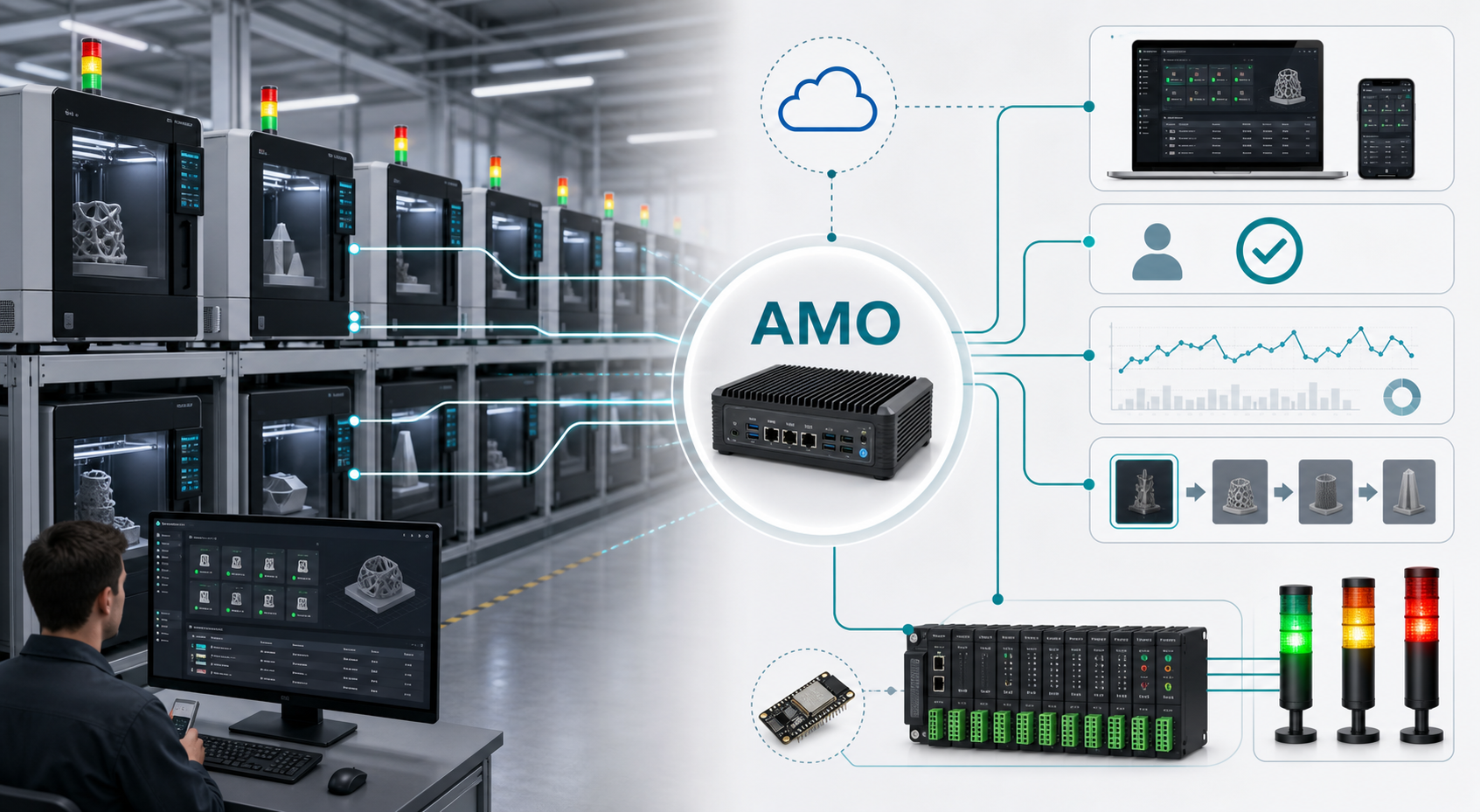
AMO brings production, materials, quality, and people together. Starting with mixed 3D printer fleets, its modular architecture is designed to grow across manufacturing processes.
02 / The platform
Manufacturing execution (MES), material planning (MRP), and product lifecycle management (PLM). One connected product vision, developed progressively.
Production orders, queues, work in progress, assignment, execution history, and completion.
Demand versus capacity, resource availability, downtime, maintenance windows, and supervisor-controlled priorities.
Material replenishment, readiness, setup, part removal, and operator actions across manufacturing routes.
Preventive and corrective maintenance, operating hours and cycles, asset history, equipment holds, and release.
Common operational states, visible setup requests, actionable alerts, and notifications to responsible personnel.
Inspections, defect categories, evidence photos, scrap, rework, and reprints linked to production history.
PDCA and 8D-style investigations, recurring issue analysis, and controlled machine blocking and release.
Requirements, stock, loaded material, estimated remaining quantities, consumption, and BOM-driven demand.
Product definitions, model codes, revisions, bills of materials, manufacturing programs, and controlled process routings.
Material, machine time, labor, overhead, scrap, rework, and maintenance allocation to understand cost and margin.
Genealogy connecting each unit to demand, orders, programs, equipment, materials, events, and quality records.
Shopify and other demand channels, heterogeneous equipment interfaces, and industrial and business systems.
Selected external production and fulfillment visibility, with access separated from internal operational controls.
03 / Architecture
Business demand above. Manufacturing resources below. AMO connects both through a common operational model, with local production and optional remote services.
Local manufacturing platform
Demand · Planning · Execution · Quality · Materials · Maintenance
04 / Traceability
Distinct orders, programs, batches, and units. Connected records from customer demand through production, quality, and shipment.
Same product, material, and color
One production batch
Illustrative batching example. A sales order may also generate multiple production orders; each production order may manufacture one or many units.
05 / The process
Four stages. Eighteen connected steps. AMO supports machine selection and a FIFO queue, with supervisors controlling priorities.
Stage 1
Stage 2
Stage 3
Stage 4
When a failure is detected, pause or stop the machine where supported, activate Andon, and notify responsible personnel. Link the event to the machine, production order, program, and affected units. An authorized operator or supervisor returns the affected quantity to production and chooses FIFO or a justified priority.
Rejected parts can generate defect records with photos, scrap, rework, or reprint decisions. Serious or recurring problems may initiate corrective action and equipment blocking until authorized release.
06 / People
Human-supervised planning comes first. AMO identifies viable resources, flags setup needs, and supplies the data for informed decisions.
Reviews capacity, manages queue priorities, oversees production conditions, and decides justified exceptions to FIFO.
Turns demand into production orders, groups compatible quantities, defines material and color requirements, prepares the program, and releases work.
Maintains material readiness, performs setup, removes parts, responds to Andon alerts, and advances work through its routing.
Preserves traceability, manages queues and states, identifies viable equipment and setup needs, monitors machines, and records events.
07 / Operational states
Completion at the machine is a handoff. Removal, inspection, finishing, and acceptance follow before shipment.
RECEIVED / PREPARATION REQUIRED
CREATED / PREPARED / QUEUED
READY / RUNNING / WAITING FOR SETUP / ATTENTION REQUIRED / FAILURE / MAINTENANCE / BLOCKED
QUEUED / IN PRODUCTION / COMPLETED / FAILED / REQUEUED
REVIEW / FINISHING / READY FOR SHIPMENT / PACKED / AWAITING COLLECTION / SHIPPED
Andon communicates running, waiting for setup, attention, failure, maintenance, and blocked conditions. Signal colors, escalation rules, and notification policies are still to be defined.
08 / What's next
Single-color and multi-color additive production first. A reusable model for CNC, injection molding, assembly, and testing over time.
Mixed printer fleets, production preparation, supervised queues, material readiness, setup, execution monitoring, failure recovery, and downstream fulfillment.
Unit genealogy, controlled revisions and routings, quality and corrective action, maintenance, costing, capacity analysis, and increasingly capable planning.
Order splitting and consolidation rules, unit identifiers, spool identity, adapters, inspection plans, release authority, TPM rules, security, audit controls, and customer status mapping.